

You've just finished your round. You three-putted the 4th, found the pond on the 7th, and somehow holed a 30-foot putt on the 18th. Back in the clubhouse, someone in your group mentions they're "down to 14" and everyone nods as if that means something.
It does. That number is a golf handicap, and once you understand it, golf changes. You can play a fair match against someone who has played for twenty years. You can tell whether your practice is working. And bad days on the course stop feeling quite so final.
This guide explains what a handicap is, what the numbers mean, how they're calculated, and how to start tracking your own. No maths degree required.
What is a golf handicap?
A golf handicap is a number that measures your ability. The lower it is, the better you play. In the official system, handicaps run from a maximum of 54.0 down to zero, and the very best amateurs go below zero into "plus" figures.
Think of it as your potential rather than your average. It reflects what you're capable of on a good day, not what you shoot every time.
Here's roughly what different numbers look like on an average par-72 course:
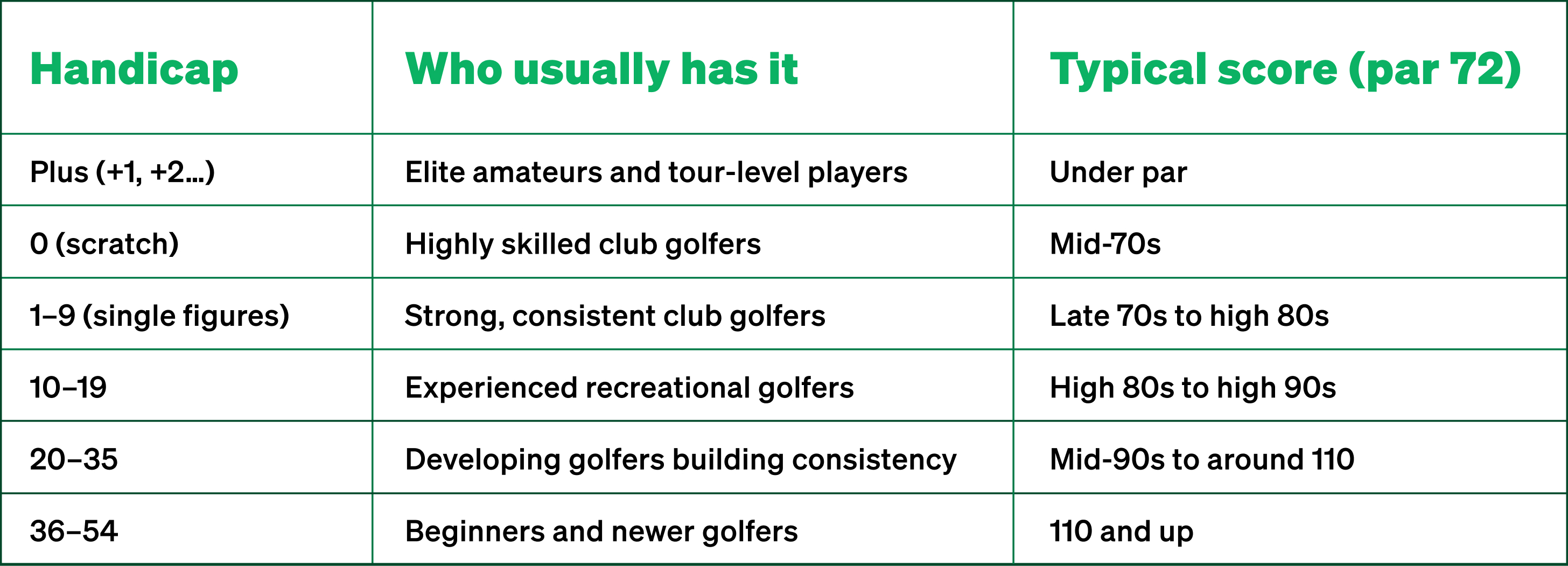
These are rough guides, not official categories. Typical scores sit a few strokes above par plus handicap, because your handicap is based on your better rounds.
If you're near the top of the table, don't worry. Everyone starts there, and the first few years are when handicaps fall fastest.
How a handicap levels the playing field
Meet Alex and Sam. Alex has played since school and has a handicap of 8. Sam took up golf last spring and is on 24. Play a straight match and Alex wins nine times out of ten. Neither of them enjoys that much.
Handicaps fix this. Sam receives extra strokes, so the match comes down to who plays better relative to their own ability that day.
Gross score vs net score
Your gross score is the number of strokes you actually took. Your net score is your gross score minus the handicap strokes you receive.
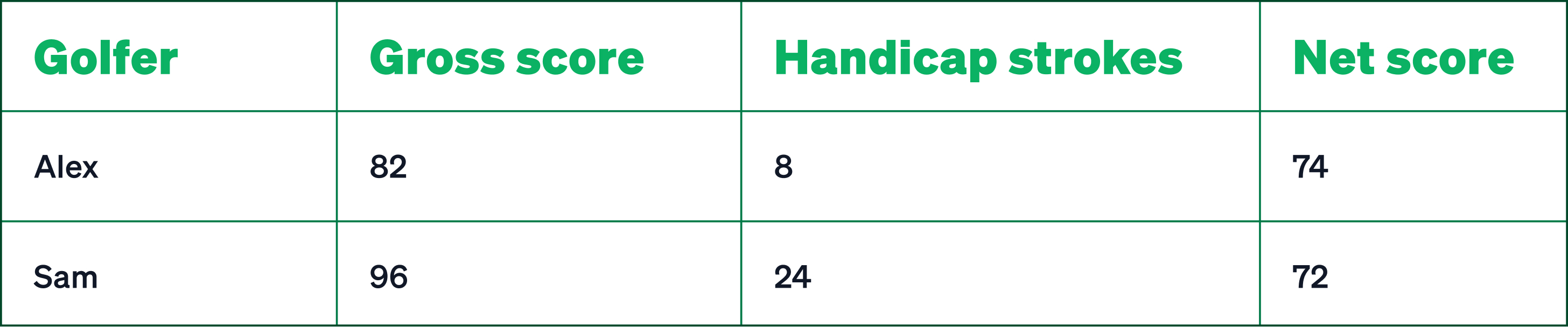
Alex took 14 fewer strokes, but Sam wins on net. Sam played better for Sam than Alex did for Alex.
This is simplified. In practice, the strokes you receive depend on the course, the tees and the game format. But the principle holds, and it's why a beginner and a single-figure golfer can have a genuinely close match.
How is a golf handicap calculated?
It's tempting to think your handicap is your average score minus par. Shoot 95 on a par-72 course and you're a 23, right? Not quite, because shooting 95 on a tight, windy links is a very different achievement from shooting 95 on a short parkland course.
Official handicaps deal with this in four steps. You never have to do the maths yourself, but knowing the idea makes the number make sense.
Step 1: Every course is rated for difficulty
Each set of tees gets two difficulty ratings from the national golf association. The first estimates what an expert, zero-handicap golfer would shoot there, for example 71.2 on a par-72 course. The second measures how much harder the course plays for higher-handicap golfers than for experts. A short, open course rates low; a long one with water and narrow fairways rates high.
You'll usually find both numbers printed on the scorecard.
Step 2: Each round is adjusted for difficulty
After a round, your score is compared with the expert benchmark, then scaled for how tough the course is for someone at your level. The result is one number that shows how well you really played, wherever you played.
Disaster holes are capped, too, so a single 11 on a par 4 doesn't wreck your record.
Sam's example: Sam shoots 98 on a par-72 course where an expert would expect to shoot 71.2. That's 26.8 shots above the benchmark. But this course plays harder than average for higher-handicap golfers, so the gap is scaled down by about 12%. Sam's adjusted result for the round is 23.7.
Shoot the same 98 on an easier course and the adjusted result would be higher, because 98 there is a weaker performance.
Step 3: Your best rounds set your handicap
Your handicap is the average of your best 8 adjusted results from your most recent 20 rounds. That's why one terrible day barely moves it, and why a handicap reflects your potential rather than your average.
New golfers can get their first official handicap after 54 holes, for example three 18-hole rounds or six 9-hole rounds.
Step 4: Today's strokes depend on today's course
Before you tee off, your handicap is converted into the number of strokes you receive on that particular course and set of tees. Harder course, more strokes. With a handicap of 24.0, Sam would receive 26 strokes on the course above, and fewer on an easier one.
The good news: golf apps handle all of this for you, as you'll see below.
Do you need an official handicap?
Only if you want to play in official competitions, or if your club or course requires one. Plenty of golfers play for years without one and enjoy every minute.
Official handicaps are issued by national golf associations, usually through a member club. You register, submit scores from qualifying rounds, and the association keeps your official record. The exact process varies by country, so your local club is the best place to ask.
Unofficial handicaps are for everyone else: the weekend golfer, the pay-and-play regular, the friend who just wants a fair match. They won't get you into a club competition, but they tell you where your game stands and make casual games fairer.

How to lower your golf handicap
Most beginners assume they need to hit the ball farther. Usually, they need to stop giving shots away.
1. Kill the big numbers
A triple bogey costs you as much as three bogeys. Most high-handicap rounds are ruined by a few disaster holes, not by a lack of birdies. When you're in trouble, take your medicine: chip back to the fairway instead of threading a 3-iron through the trees.
2. Get rid of three-putts
If you three-putt five times a round, that's five strokes you can win back without changing your swing. Spend practice time on putts from 30 feet and further, getting the first one close rather than holing it.
3. Practise inside 50 yards
For many beginners, the short game is where the most strokes disappear: duffed chips, bunker shots that stay in, pitches that fly the green. Half an hour a week around the practice green often does more than a bucket of drivers.
4. Find out where you're actually losing strokes
Your memory of a round is biased. You remember the great drive on the 3rd, not the four fairways you missed. Recording fairways, greens and putts for a few rounds shows you exactly what to work on. Golf GameBook's statistics track all of this automatically.
5. Judge your progress over months, not rounds
Golf improvement is never a straight line. A bad round doesn't mean you've got worse. Look at the trend across 10 or 20 rounds, and celebrate small wins along the way: your first round under 110, your first par, your first time breaking 100.
Track your playing level with GGB Handicap
Knowing how handicaps work is one thing. Keeping track of yours is another, and nobody wants to spend the evening after a round doing score differentials on a calculator.
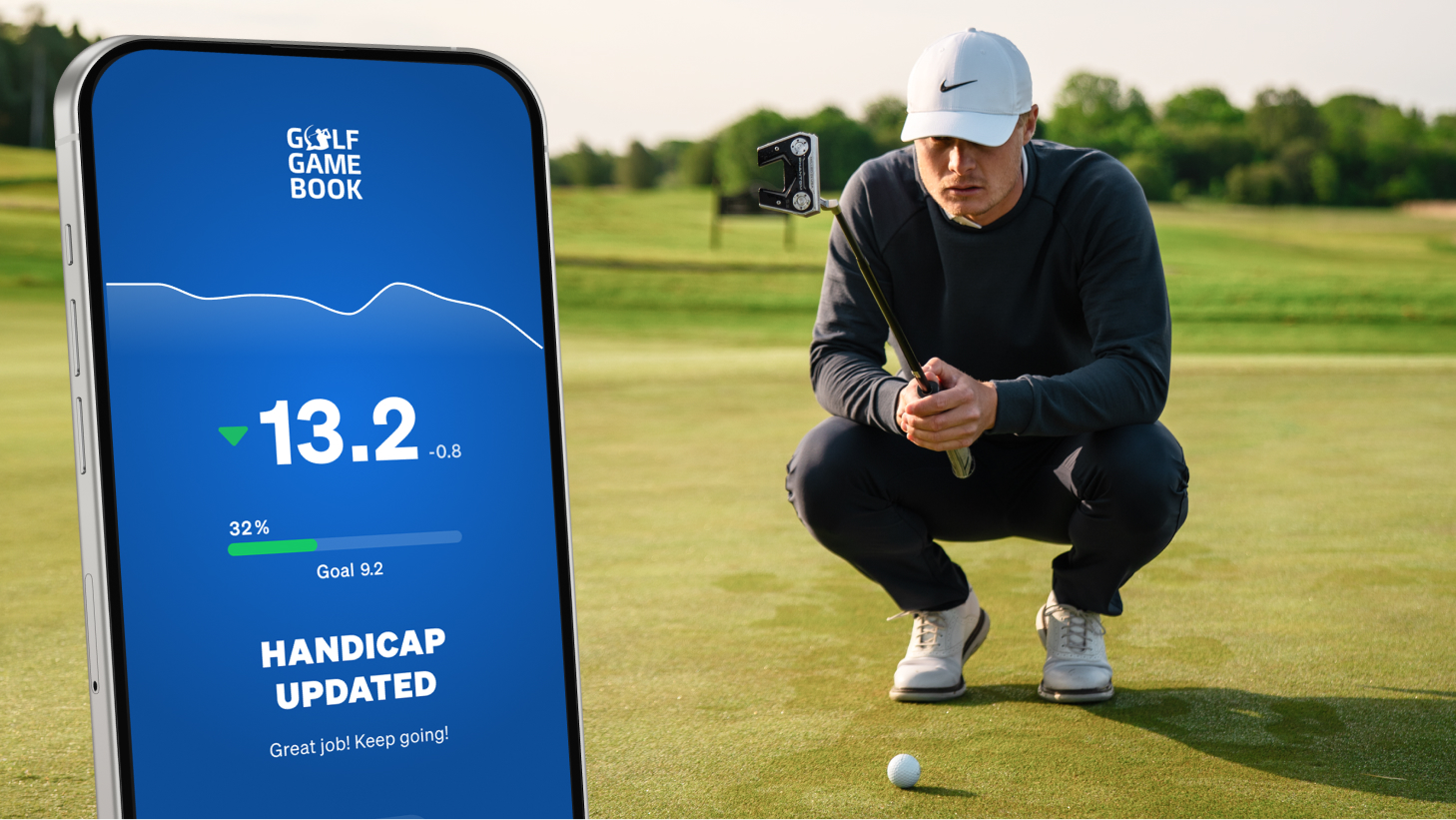
GGB Handicap is Golf GameBook's own handicap feature, built for everyday golfers who want to know where their game stands. Record an eligible round in the app, and your GGB Handicap is recalculated automatically as soon as you finish. No spreadsheets, no waiting until tomorrow.
With GGB Handicap you can:
- Watch your progress. Every round is saved, so you can look back and see how far you've come.
- Set a goal. Pick a target handicap and track how close you're getting.
- Play fairer games with friends. Handicaps are applied for you, across more than 20 game formats, with live scoring and leaderboards.
GGB Handicap is an independent feature, not an official handicap issued by a golf association, and it doesn't replace one. If your home club is in Sweden, Finland, Spain, Iceland or Denmark, Golf GameBook also connects with your national federation for official handicap management.
Download Golf GameBook, record your next round, and see your GGB Handicap.
Frequently asked questions
What is a good golf handicap for a beginner?
There's no "good" number. Most beginners start somewhere between 36 and 54, and that's completely normal. What matters is that it comes down over time.
What does a 20 handicap mean?
A 20-handicapper is capable of playing to around 20 over par on an average course on a good day. Their typical scores are usually in the low-to-mid 90s on a par-72 course.
What is a scratch golfer?
A scratch golfer has a handicap of zero. On a good day, they can play to around par on a course of average difficulty.
Can you have a handicap below zero?
Yes. Golfers better than scratch have a "plus handicap", such as +2. Instead of receiving strokes, they give strokes back to the course.
What is the maximum golf handicap?
In the official system, the maximum handicap is 54.0 for all golfers, regardless of gender.
Does my handicap change after every round?
It's recalculated after every qualifying round, but it only moves if the new round changes your best 8 of the last 20. Official handicaps are updated daily. GGB Handicap recalculates as soon as you finish an eligible round.
How many rounds do I need to get a handicap?
For an official handicap, you need scores from 54 holes, for example three 18-hole rounds, to get your first handicap.
Is GGB Handicap an official handicap?
No. GGB Handicap is Golf GameBook's independent feature for tracking your ability and playing fairer games with friends. For an official handicap, contact your club or national golf association.